
A branch of chemistry that studies the physical properties of molecules and their interactions.
Topic :-
- Basic Mathematical Concepts
- Atomic and Molecular Structure
- Theory of Gasses
- Solid State
- Chemical Thermodynamics
- Chemical and phase Equilibria
- Electrochemistry
- Chemical Kinetics
- Adsorption
- Spectroscopy
Basic Mathematical Concepts
- Basic Mathematical Concepts
- Trigonometric Function
- Function
- Differentiation
- Integral of A Function
- Calculus in One Dimensional Motion
- Determinant
- Statistics
- Correlation
- Regression
- Probability
Basic Mathematical Concepts
Functions; maxima and minima; integrals; ordinary differential equations; vectors and matrices; determinants; elementary statistics and probability theory.
Important Points
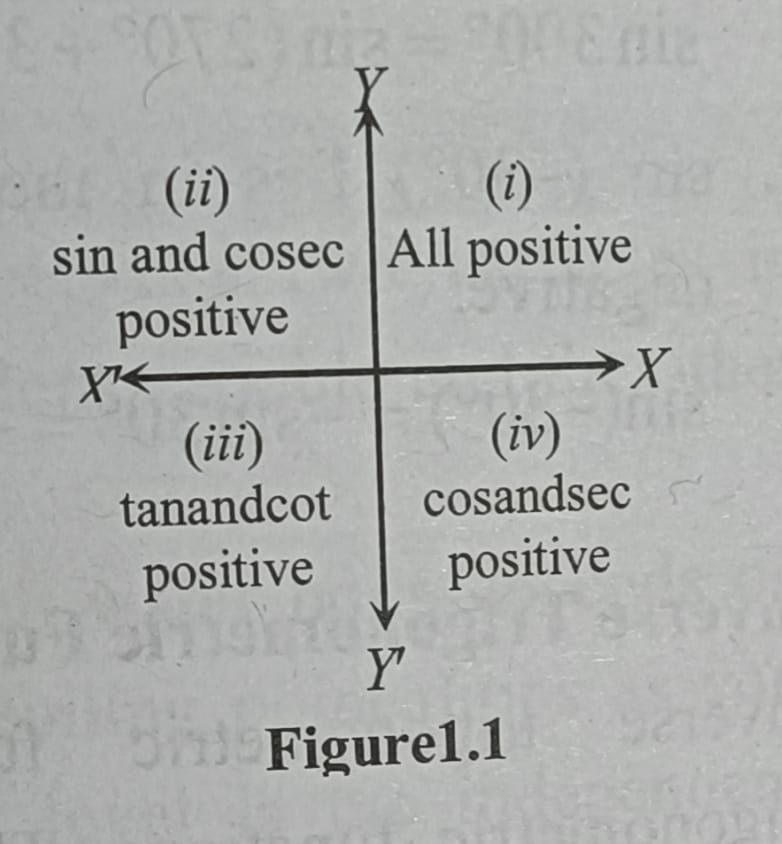
- To determine the sign of a trigonometrical ratio in any quadrant, OP is taken as positive in all the four quadrants (see Fig1.1)
- In the first quadrant, all trigonometrical ratios are positive.
- In the second quadrant, only sinθ and cosecθ are positive.
- In the third quadrant, only tanθ and secθ are positive.
- The values of sinθ and cisθ are such that – 1 ≤ sinθ ≤ 1 and –1 ≤ cosθ ≤ 1. But tanθ and cotθ can take any real value.
Trigonometric Function
Graphs of Sine and Cosine Functions
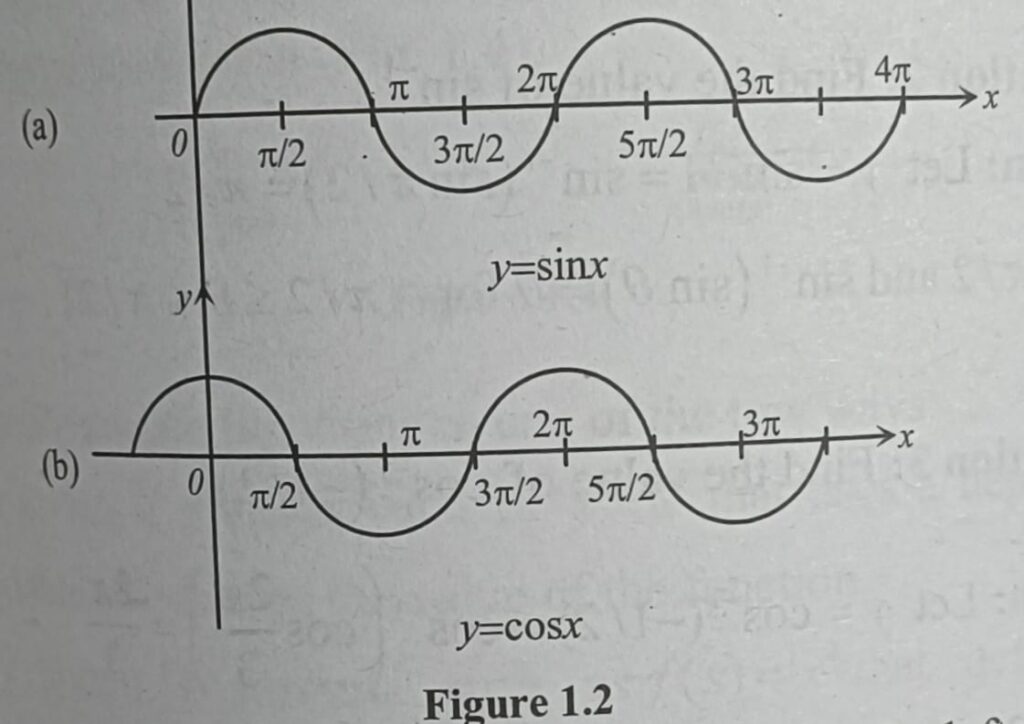
The function y=sin x , where x is any dimensionless quantity, is called a sine function. The argument x is usually measured in rad. The function y=sin x is plotted in Fig 1.2 (a). the maximum positive and negative values of a sine function are +1 and -1 , respectively. Between x=0 and x=π/2. Similarly, for the interval x=π to x=2π, the function is negative, and the negative peak occurs at x=3π/2. The sine function is a periodic function with a period of 2π. That is the pattern of the graph repeats itself after an interval of 2π.
PRABHAT PARERBACKS
If the graph of the sine function is displaced to the left through π/2, we get the graph of the cosine function y=cos x as shown in Fig 1.2 (b) . The cosine function is also a periodic function with a period of 2π.
Some Important Trigonometric Function
- (a) sin2 θ + cos2 θ = 1
(b) 1+ tan2 θ = cos2 θ
2. Addition and subtraction formulae:
(a) sin(A ± B) = sin A cos B ± cos A sin B
(b) cos(A±B) = cos A cos B ∓ sin A sin B
Trigonometrical Ratios of Allied Angle
The angles whose sum or difference with angle is zero or a multiple of 9o .
